Connections
Contents
Karachi: Organized Crime in a Key Megacity
Global Dimensions of Organized Crime and Ways of Preventing Threats at International Level
Transnational Organized Crime – Latvian Challenges and Responses
Maritime Piracy as a Form of Organized Crime: A Strategic Management Approach
Cyberspace as the Environment Affected by Organized Crime Activity
The Mobilization and Recruitment of Foreign Fighters: The Case of Islamic State, 2012–2014
Abstract:
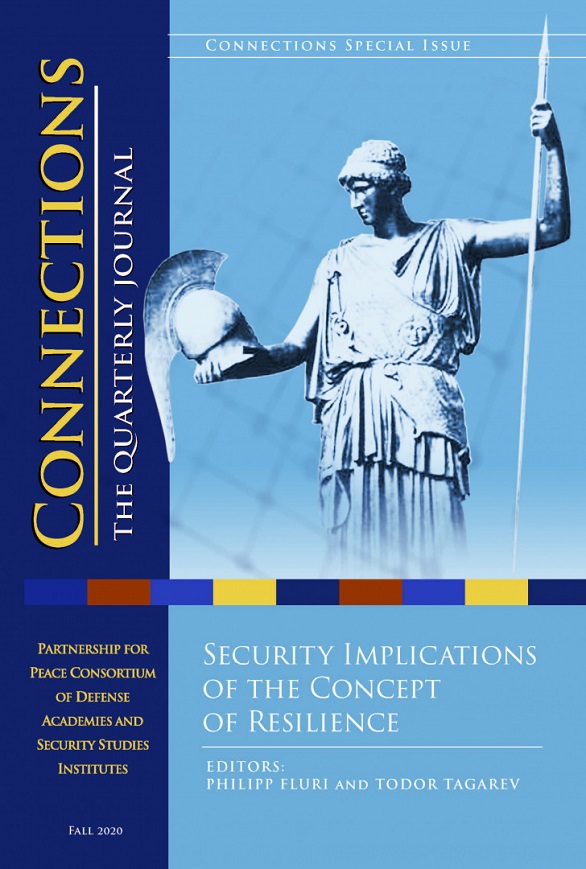
The world has entered a period of increased tension marked by larger and more frequent disasters, a widespread socio-economic crisis, and a growing sense of mistrust towards institutions and international legal frameworks. In the midst of these challenging times, the idea of resilience has caught the attention, especially that of the western world, which has been shocked by the COVID-19 pandemic. The purpose of this article is to place the word resilience within the context of contemporary crises so that the international community is not tempted to redirect some of their funds reserved for prevention and preparedness toward something ‘new.’ Specifically, the article makes three arguments. First, the concept of resilience ought to be understood rightly as a sign of elasticity. Second, resilience is not an alternative to prevention and preparedness but, rather, their result as properly identified in the Sendai Framework. Third, modern crises and the challenges they pose are an opportunity to improve the way we work, reinvigorate international and domestic systems and relations, and ultimately move forward.
Previous Issue
 Advances in sensors, communications, computing, nano- and bio-technologies, along with new strategies and operational concepts, challenge our policy-making capacity. The Spring 2016 issue of Connections presents the Emerging Security Challenges Working Group of the PfP Consortium and reflections of some of its members on the security and policy imp...
Read More
Advances in sensors, communications, computing, nano- and bio-technologies, along with new strategies and operational concepts, challenge our policy-making capacity. The Spring 2016 issue of Connections presents the Emerging Security Challenges Working Group of the PfP Consortium and reflections of some of its members on the security and policy imp...
Read More