Connections
Contents
The Persistent Demand for Defense Institution Building
NATO’s Defense Institution Building and Projecting Stability: Current Priorities and Activities
Defense Institution Building in the U.S. Context
NATO’s Defense Institution Building in the Age of Hybrid Warfare
Defense Against Negative Strategic Communications
Defense Institution Building from Above? Lessons from the Baltic Experience
Ukraine’s Security Sector Reform: Is Ukraine Taking Western Advice?
Defence Institution Building in Ukraine at Peace and at War
Defense Education Enhancement Program in Ukraine: The Limits of NATO’s Education Program
Introduction
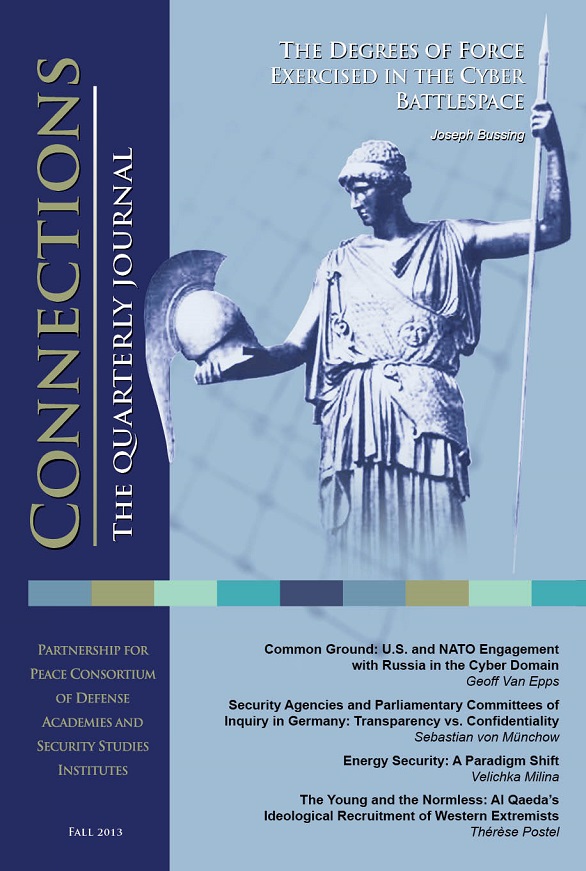
Each instance of communication via the Internet depends on the transfer of confidential, readily available, and authenticated information. If this information is read, altered, or forged in any way, it jeopardizes the secure and safe operation of any service depending on the transfer of data. Thus, the exploitation of data can be leveraged in ways that can have devastating effects on modern societies. The problem with a networked society is that the international conventions on the use of force fail to sufficiently safeguard the world from the instability caused by computer attacks. This article seeks to remedy the situation by defining what kinds of actions carried out via computerized networks constitute a use of armed force or armed conflict.
This article applies the existing Laws of Armed Conflict (LOAC) to three cases of computer-based attacks carried out by nation-states. In doing so, the aim is to highlight the legal limitations on actions that can be taken to respond to computer attacks. The first examination involves the wave of cyber attacks that precluded the 2008 South Ossetia War between Russia and Georgia. The second case addresses the United States’ covert operation, codenamed “Olympic Games.” For this case, the analysis will be focused on the Stuxnet computer program. The third case utilizes LOAC to assess the acts of digital espionage carried out by the Chinese People’s Liberation Army Unit 61398.
Using LOAC as a legal rubric, the cases suggest that there are three distinct interpretations of computer-based operations. The case of the 2008 South Ossetia War constitutes a situation in which using computers to attack another country can be interpreted as a use of force and as an act of armed conflict. The “Olympic Games” operation reveals that a computer-based attack can be considered a use of force but not an act of armed conflict. The analysis of the actions of Unit 61398 shows a perspective on computer attacks that are neither a use of force nor an act of armed conflict. Each case expresses unique characteristics of operations in cyberspace. Therefore, in order to develop a legal understanding of these cases, the analysis favors an effects-based assessment of cyber attacks, pioneered by Michael Schmitt and expressed in the Tallinn Manual on the International Law Applicable to Cyber Warfare.
Previous Issue
 Since the fall of the Soviet Union, Russia has been unprecedented in its embrace of modern technology for the execution of its foreign policy and intelligence operation. This article examines Russia’s relationship to the internet and computer technology, beginning with the early 1990s and detailing the growth of technology’s popularity with the Rus...
Read More
Since the fall of the Soviet Union, Russia has been unprecedented in its embrace of modern technology for the execution of its foreign policy and intelligence operation. This article examines Russia’s relationship to the internet and computer technology, beginning with the early 1990s and detailing the growth of technology’s popularity with the Rus...
Read More