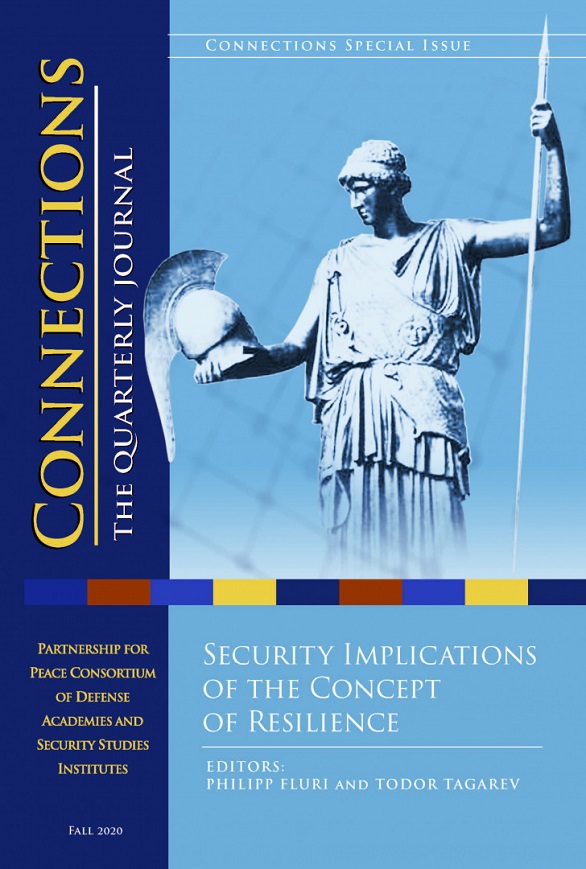
Connections
Contents
The Persistent Demand for Defense Institution Building
NATO’s Defense Institution Building and Projecting Stability: Current Priorities and Activities
Defense Institution Building in the U.S. Context
NATO’s Defense Institution Building in the Age of Hybrid Warfare
Defense Against Negative Strategic Communications
Defense Institution Building from Above? Lessons from the Baltic Experience
Ukraine’s Security Sector Reform: Is Ukraine Taking Western Advice?
Defence Institution Building in Ukraine at Peace and at War
Defense Education Enhancement Program in Ukraine: The Limits of NATO’s Education Program
Abstract:
International stabilization missions are often unsuccessful, as demonstrated by the fact that a large number of countries that have hosted such missions have also relapsed into conflict within 20 years. The author suggests looking to experiences of resilience-based peacebuilding for more successful examples. These remain largely unknown or ignored and still do not enjoy the attention they deserve, whether because the ‘wrong’ NGO crowd dominates peacebuilding programming, the ‘wrong’ departments and ministries are considered the main peacebuilding partners or the resilience-based projects simply are not costly enough to attract attention. A framework for resilience and examples from Guatemala, Liberia, Timor-Leste, and Afghanistan are discussed and lessons to be learned identified.
Previous Issue
 Since the fall of the Soviet Union, Russia has been unprecedented in its embrace of modern technology for the execution of its foreign policy and intelligence operation. This article examines Russia’s relationship to the internet and computer technology, beginning with the early 1990s and detailing the growth of technology’s popularity with the Rus...
Read More
Since the fall of the Soviet Union, Russia has been unprecedented in its embrace of modern technology for the execution of its foreign policy and intelligence operation. This article examines Russia’s relationship to the internet and computer technology, beginning with the early 1990s and detailing the growth of technology’s popularity with the Rus...
Read More