Connections
Contents
Karachi: Organized Crime in a Key Megacity
Global Dimensions of Organized Crime and Ways of Preventing Threats at International Level
Transnational Organized Crime – Latvian Challenges and Responses
Maritime Piracy as a Form of Organized Crime: A Strategic Management Approach
Cyberspace as the Environment Affected by Organized Crime Activity
The Mobilization and Recruitment of Foreign Fighters: The Case of Islamic State, 2012–2014
Abstract:
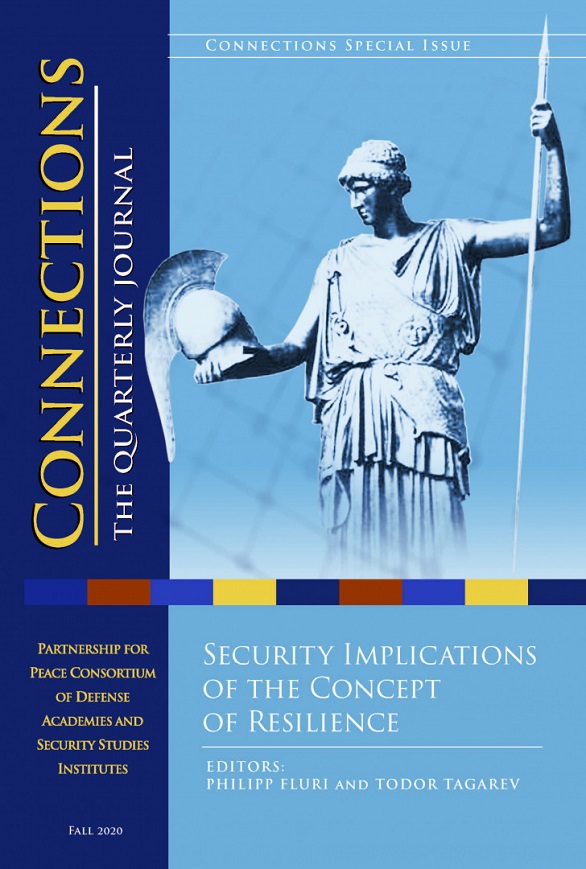
International stabilization missions are often unsuccessful, as demonstrated by the fact that a large number of countries that have hosted such missions have also relapsed into conflict within 20 years. The author suggests looking to experiences of resilience-based peacebuilding for more successful examples. These remain largely unknown or ignored and still do not enjoy the attention they deserve, whether because the ‘wrong’ NGO crowd dominates peacebuilding programming, the ‘wrong’ departments and ministries are considered the main peacebuilding partners or the resilience-based projects simply are not costly enough to attract attention. A framework for resilience and examples from Guatemala, Liberia, Timor-Leste, and Afghanistan are discussed and lessons to be learned identified.
Previous Issue
 Advances in sensors, communications, computing, nano- and bio-technologies, along with new strategies and operational concepts, challenge our policy-making capacity. The Spring 2016 issue of Connections presents the Emerging Security Challenges Working Group of the PfP Consortium and reflections of some of its members on the security and policy imp...
Read More
Advances in sensors, communications, computing, nano- and bio-technologies, along with new strategies and operational concepts, challenge our policy-making capacity. The Spring 2016 issue of Connections presents the Emerging Security Challenges Working Group of the PfP Consortium and reflections of some of its members on the security and policy imp...
Read More