Connections
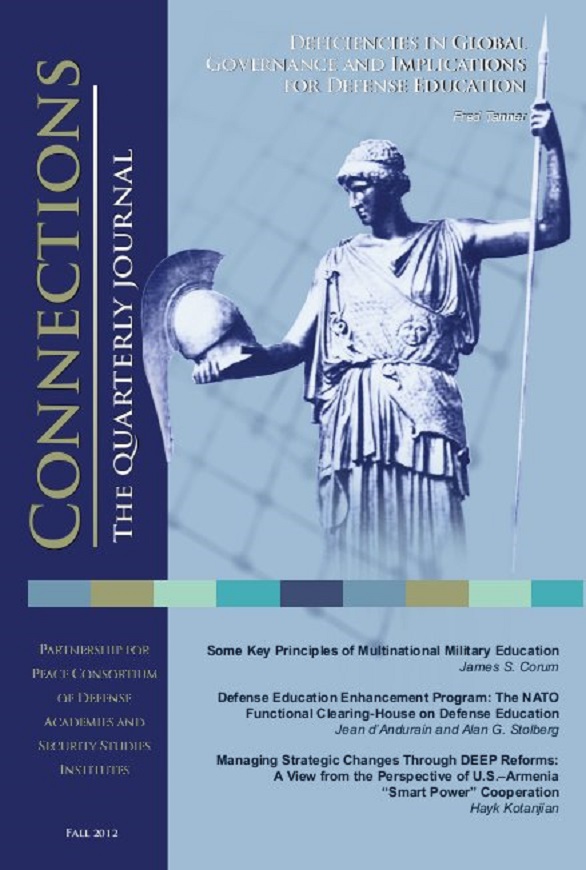
Contents
The Persistent Demand for Defense Institution Building
NATO’s Defense Institution Building and Projecting Stability: Current Priorities and Activities
Defense Institution Building in the U.S. Context
NATO’s Defense Institution Building in the Age of Hybrid Warfare
Defense Against Negative Strategic Communications
Defense Institution Building from Above? Lessons from the Baltic Experience
Ukraine’s Security Sector Reform: Is Ukraine Taking Western Advice?
Defence Institution Building in Ukraine at Peace and at War
Defense Education Enhancement Program in Ukraine: The Limits of NATO’s Education Program
A new security environment dramatically different from that which defined NATO’s mission at its inception poses different challenges for collective action. Newly emerging global threats such as terrorism, cyber attacks, and the proliferation of weapons of mass destruction confront both existing Alliance members and its global partners. NATO must also consider the nature of partnership itself, and the role NATO might play in building its partners’ capacity to address global threats, participate in coalition operations, and enhance defense reform.
These themes—security and partnerships—were key to the NATO Lisbon Summit (held in November 2010) and the newly crafted NATO Strategic Concept. According to the recommendations of the Group of Experts on NATO’s new strategic concept, “For NATO 2020, the twin imperative is assured security for all its members and dynamic engagement beyond the treaty area to minimize threats.” Former U.S. Secretary of Defense Robert Gates identified building partner capacity as a critical element in promoting and sustaining security. In an article in the May-June 2010 issue of Foreign Affairs, Secretary Gates wrote, “[There] has not been enough attention paid to building the institutional capacity (such as defense ministries) or human capital (including leadership skills and attitudes) needed to sustain security over the long term.”
Previous Issue
 Since the fall of the Soviet Union, Russia has been unprecedented in its embrace of modern technology for the execution of its foreign policy and intelligence operation. This article examines Russia’s relationship to the internet and computer technology, beginning with the early 1990s and detailing the growth of technology’s popularity with the Rus...
Read More
Since the fall of the Soviet Union, Russia has been unprecedented in its embrace of modern technology for the execution of its foreign policy and intelligence operation. This article examines Russia’s relationship to the internet and computer technology, beginning with the early 1990s and detailing the growth of technology’s popularity with the Rus...
Read More