Connections
Contents
The Persistent Demand for Defense Institution Building
NATO’s Defense Institution Building and Projecting Stability: Current Priorities and Activities
Defense Institution Building in the U.S. Context
NATO’s Defense Institution Building in the Age of Hybrid Warfare
Defense Against Negative Strategic Communications
Defense Institution Building from Above? Lessons from the Baltic Experience
Ukraine’s Security Sector Reform: Is Ukraine Taking Western Advice?
Defence Institution Building in Ukraine at Peace and at War
Defense Education Enhancement Program in Ukraine: The Limits of NATO’s Education Program
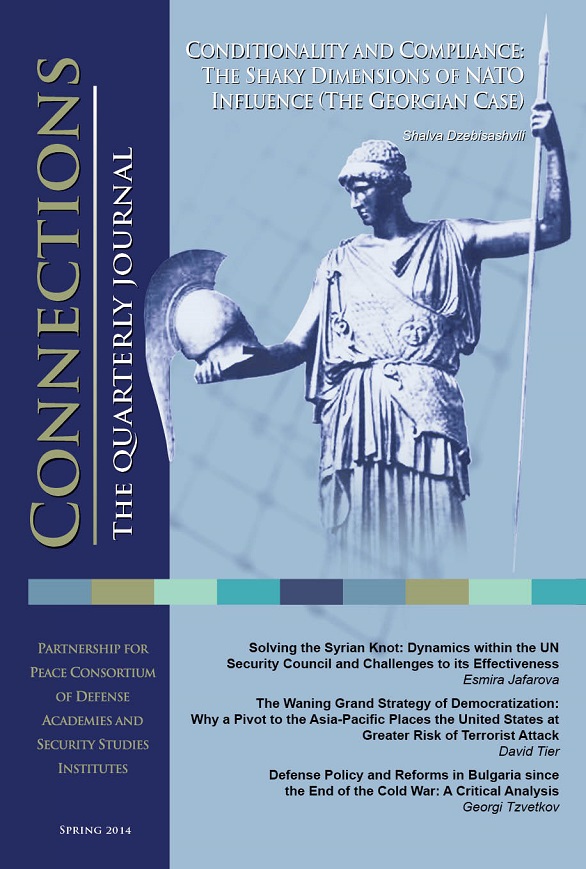
This article intends to highlight the dynamics within the UN Security Council (UNSC) with regard to the events in the Syrian Arab Republic that have unfolded in the wake of the so-called “Arab Spring” and perturbed the entire region of the Middle East. What had begun as peaceful demonstrations against the incumbent leadership of the country very quickly transformed into the violent conflict that has raged for about three years. As a primary world body fulfilling the watchdog functions over the protection of international peace and security, the UNSC was overwhelmed by the highly dynamic nature of the situation on the ground, and was embroiled in intensive deliberations on the ways to solve the Syrian crisis.
Dynamics within the Security Council involved great deal of twists and turns that were mostly conditioned by internal factors. During the initial phase of the conflict, the Council actively searched for paths out of the conflict, and worked in unison with its Joint Special Envoy Kofi Annan on a variety of options to end the military hostilities. However, subsequent events brought to the fore a set of irreconcilable divisions within the Council that undermined its unity and alienated the Joint Special Envoy, who cited the lack of support from the Council as the primary reason for his resignation. Further deterioration of the security situation in Syria and the dramatic rise in the number of human casualties threw the Council into prolonged discussions on solving the crisis. But these new discussions did not render the Council able to overcome its internal divisions that perpetuated its inability to speak with a unified voice and take a stronger stance toward conflict resolution.
This article will first seek to highlight the course of events in Syria, in chronological order; these events will then be employed in the analysis of factors that influenced the Council’s ability to effectively handle the Syrian crisis. The analysis will suggest that the existing institutional challenges and actors’ interests remain the primary obstacles to the Council’s ability to demonstrate a unified stance and take stronger action via application of its potent policy instruments, such as Chapter VII of the UN Charter. For a clearer perception of the power politics and overall atmosphere of decision making within the Security Council vis-à-vis the Syrian crisis, comparisons will also be made to the Council’s actions on the Libyan and Yemeni cases. Without offering any affirmative solutions as to whether the employment of Chapter VII measures could have delivered an effective solution to the Syrian crisis, the essay will conclude that the main reason for the relative success of the Security Council in the Libyan and Yemeni cases when compared to its failure in the Syrian instance was the actual implementation of the use of force or a threat to effectuate the Chapter VII measures. As the conflict lingers on, future developments and analysis of the Security Council’s actions should definitely remain among the priority areas for future research.
Previous Issue
 Since the fall of the Soviet Union, Russia has been unprecedented in its embrace of modern technology for the execution of its foreign policy and intelligence operation. This article examines Russia’s relationship to the internet and computer technology, beginning with the early 1990s and detailing the growth of technology’s popularity with the Rus...
Read More
Since the fall of the Soviet Union, Russia has been unprecedented in its embrace of modern technology for the execution of its foreign policy and intelligence operation. This article examines Russia’s relationship to the internet and computer technology, beginning with the early 1990s and detailing the growth of technology’s popularity with the Rus...
Read More