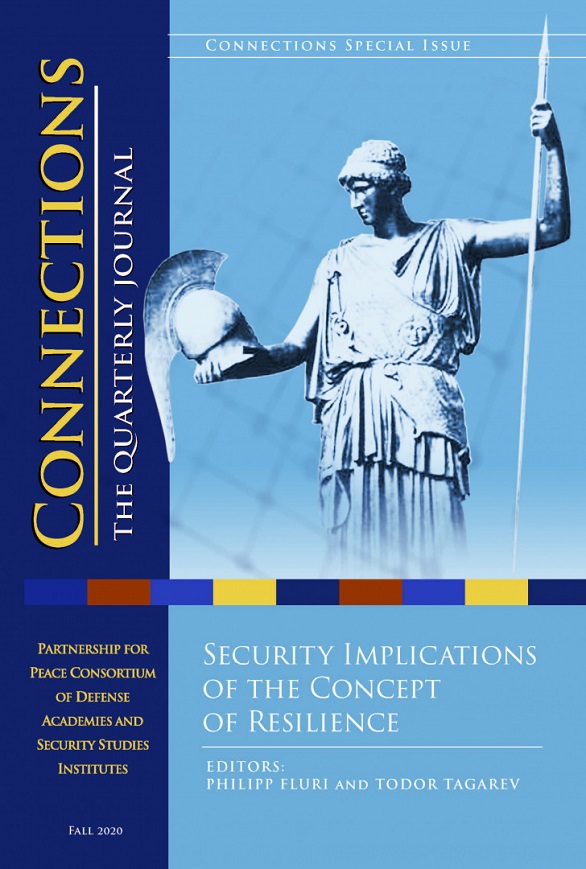
Connections
Contents
The Persistent Demand for Defense Institution Building
NATO’s Defense Institution Building and Projecting Stability: Current Priorities and Activities
Defense Institution Building in the U.S. Context
NATO’s Defense Institution Building in the Age of Hybrid Warfare
Defense Against Negative Strategic Communications
Defense Institution Building from Above? Lessons from the Baltic Experience
Ukraine’s Security Sector Reform: Is Ukraine Taking Western Advice?
Defence Institution Building in Ukraine at Peace and at War
Defense Education Enhancement Program in Ukraine: The Limits of NATO’s Education Program
Abstract:
This article reexamines the infamous concept of the “Energy Empire,” formulated by Anatoli Tchubais, and makes an attempt to reveal the instruments and ways of Russian economic influence in Georgia that lead to the formation of the so-called Russian economic footprint in the country, which in turn is effectively instrumentalized by Kremlin as a powerful tool for malign political influence and pressure. The problem is very much related to the ability of young and fragile democracies to develop resilient political systems and institutions, to withhold the pressure, and uphold the irreversible process of democratic transformation. The analysis of the major sectors of the national economy in Georgia reveals the critical dependence of major sectors on Russian operated companies as well as the growing aggregated weight of Russia’s influence in the entire national economy. The preliminary results drawn from the sectoral analysis are augmented by a regression model applied to verify the interrelation between the dynamics of democratic institutional development and a selected economic variable, i.e., exports to Russia.
Previous Issue
 Since the fall of the Soviet Union, Russia has been unprecedented in its embrace of modern technology for the execution of its foreign policy and intelligence operation. This article examines Russia’s relationship to the internet and computer technology, beginning with the early 1990s and detailing the growth of technology’s popularity with the Rus...
Read More
Since the fall of the Soviet Union, Russia has been unprecedented in its embrace of modern technology for the execution of its foreign policy and intelligence operation. This article examines Russia’s relationship to the internet and computer technology, beginning with the early 1990s and detailing the growth of technology’s popularity with the Rus...
Read More