Connections
Contents
Karachi: Organized Crime in a Key Megacity
Global Dimensions of Organized Crime and Ways of Preventing Threats at International Level
Transnational Organized Crime – Latvian Challenges and Responses
Maritime Piracy as a Form of Organized Crime: A Strategic Management Approach
Cyberspace as the Environment Affected by Organized Crime Activity
The Mobilization and Recruitment of Foreign Fighters: The Case of Islamic State, 2012–2014
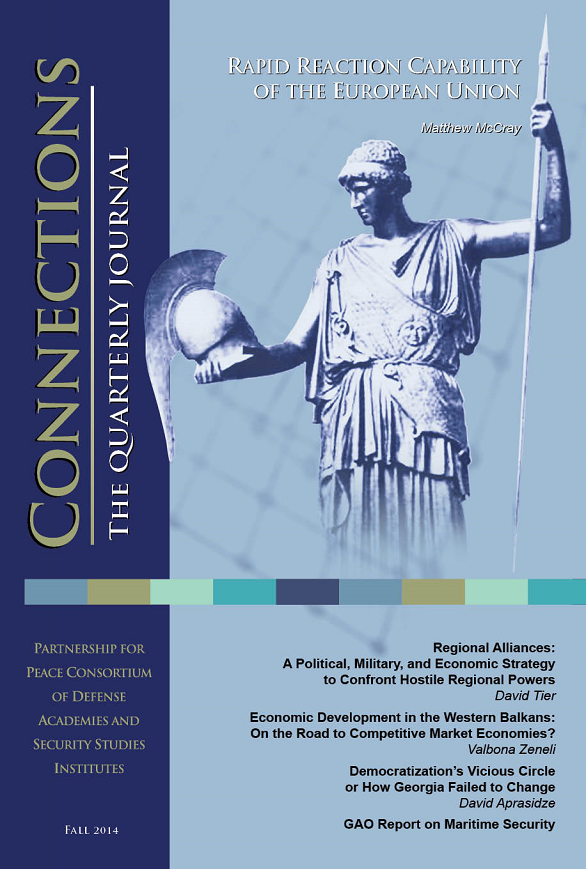
The formation of an Army of Europe has been discussed almost since the end of World War II, but has yet to be realized. After reading through the numerous and varied proposals over the past sixty years, the observer invariably arrives at the conclusion that all concerned parties agree: the European Union (EU) should have its own military. The Union today, taken as a whole, is an economic and cultural superpower. Its leading nations seem to be willing to pursue the status of a humanitarian superpower and leader in conflict prevention, as well as to defend the Europe’s perceived collective interests in the world.
Instability is rampant around the fringes of the EU; and situations abound that could require a quick and decisive application of military force. The outcomes of the Arab Spring are not yet clear, but its effects will reverberate for years to come. Al-Qaida affiliates are growing in strength in Central Africa. Ethnic enclaves and unresolved territorial disputes still remain across Eastern Europe and Central Asia, while the effects of the Syrian civil war have already spread into neighboring countries. With the impending conclusion of the International Criminal Tribunals for the former Yugoslavia, Europe is determined to put the unpleasant specter of the Balkan wars firmly in the past. Most recently, Europe has been made keenly aware of the limits of soft power by Russia’s seizure of Crimea and its continuing threat to eastern Ukraine.
Previous Issue
 Advances in sensors, communications, computing, nano- and bio-technologies, along with new strategies and operational concepts, challenge our policy-making capacity. The Spring 2016 issue of Connections presents the Emerging Security Challenges Working Group of the PfP Consortium and reflections of some of its members on the security and policy imp...
Read More
Advances in sensors, communications, computing, nano- and bio-technologies, along with new strategies and operational concepts, challenge our policy-making capacity. The Spring 2016 issue of Connections presents the Emerging Security Challenges Working Group of the PfP Consortium and reflections of some of its members on the security and policy imp...
Read More