Connections
Introduction: The Puzzle
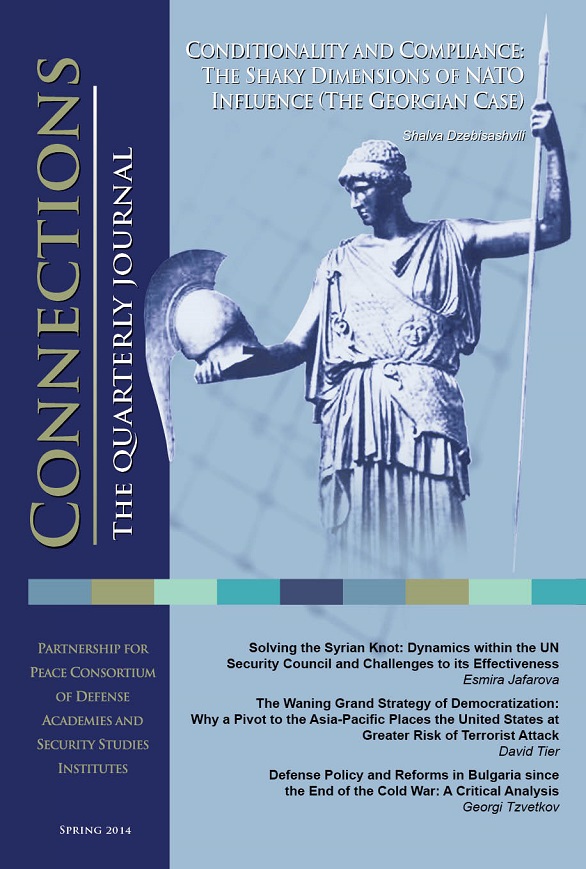
It is no secret that NATO exerts global influence, and is an organization without which the international security architecture would be difficult to imagine. Its capacity to exert influence ranges from the very material dimension of military power to the elusive and intangible effects of functional professionalization. Its unifying power was recognized long before the fall of the Berlin Wall, motivating Karl Deutsch to assign to it the quality of the “Community” in the North Atlantic area. The paradigm of the Cold War heavily influenced the way scholarship evaluated the Alliance. Despite numerous and valuable attempts, the majority of academic contributions to the study of NATO remained policy-driven. The discussion was subsumed by broader regional security studies and international relations scholarship that repeatedly brought up the question of the Alliance’s organizational purpose and durability, leaving other significant questions unexamined.
This article will attempt to address the existing scholarly deficit by focusing on a particular aspect of NATO analysis: the Alliance’s capacity to influence aspirant countries’ policy making (formulation and implementation) in the defense area and, by doing that, to ensure compliance with commonly agreed norms and standards. The case of Georgia would serve here as the best example of a country that eagerly stated its willingness to join NATO (as early as the Prague Summit in 2002) and since then has firmly followed the chosen path towards full membership. The time span (nine years) to review is sufficient to disregard the risk of early or premature statements that would be symptomatic of early stages of cooperation. The intensity and density of the relationship between NATO and the Georgian Ministry of Defense led to the creation of a complex set of issue areas in which the processes of integration have unfolded, and the national/domestic constituencies have been exposed to various modes of external institutional influence. The question of national compliance is inherently related to the concept of conditionality, due to the core principle of agreement between two actors, where one gets rewarded by another if certain conditions (i.e., commitments) are fulfilled. Thus, by highlighting particular aspects of defense cooperation between the Alliance and Georgia, we hope not only to provide more insight into the ability of the Alliance to apply various mechanisms of compliance, but also to examine the limitations of those mechanisms, as well as the domestic factors and political incentives that either supported the national decision to comply or in fact impeded any decisions, leading to domestic political cleavages and to a heightening of international (NATO) concerns.
The essay is designed in such a way as to provide first a brief overview of the literature on NATO and its inherent deficits from the standpoint of influence on aspirant countries’ decisions. Second, we will operationalize the concept of NATO conditionality in order to devise our line of argument and the hypothesis, to delineate the core objectives that an aspirant country such as Georgia must reach in the area of defense, and to demonstrate the practical utility of existing institutional mechanisms in reaching those objectives. Next we will try to validate the achievements of the Georgian Ministry of Defense (henceforth Geo MOD) by looking at various data sources, often not directly related to defense. Obviously, the high sensitivity of security-relevant issues meant that most of the relevant data reside in classified records, significantly reducing the amount of publicly accessible information. Nevertheless, the pool of sources containing disclosed official documents, legal acts, media interviews, official statements, news, etc. provide a solid foundation for launching our analytical investigation. Last, we will carefully sort out the effects of conditionality (positive compliance, and negative non-compliance) caused by NATO from those caused by domestic factors (incentives and calculations) in order to establish a high degree of causal relationship between external influences (conditionality) and domestic effects (compliance).
Previous Issue
 The Summer 2017 issue of Connections presents original research in the role of strategic communication, or StratCom, in shaping the image of a security sector organization with examples from the experience of the US and Ukraine, lessons learned from the decades long conflict in Western Sahara, and the interplay of NATO and Russia's interests in the...
Read More
The Summer 2017 issue of Connections presents original research in the role of strategic communication, or StratCom, in shaping the image of a security sector organization with examples from the experience of the US and Ukraine, lessons learned from the decades long conflict in Western Sahara, and the interplay of NATO and Russia's interests in the...
Read More